September 9, 2026
Books With Riddles and Puzzles for Kids: 9 Mystery Adventures for Ages 8–12
For kids who love riddles, coded clues, secret messages and mysteries they can solve along the way, these puzzle-filled adventures make reading feel more like a challenge than an assignment.
Books With Riddles and Puzzles for Kids
Some readers don’t just want to follow a story.
They want to solve it.
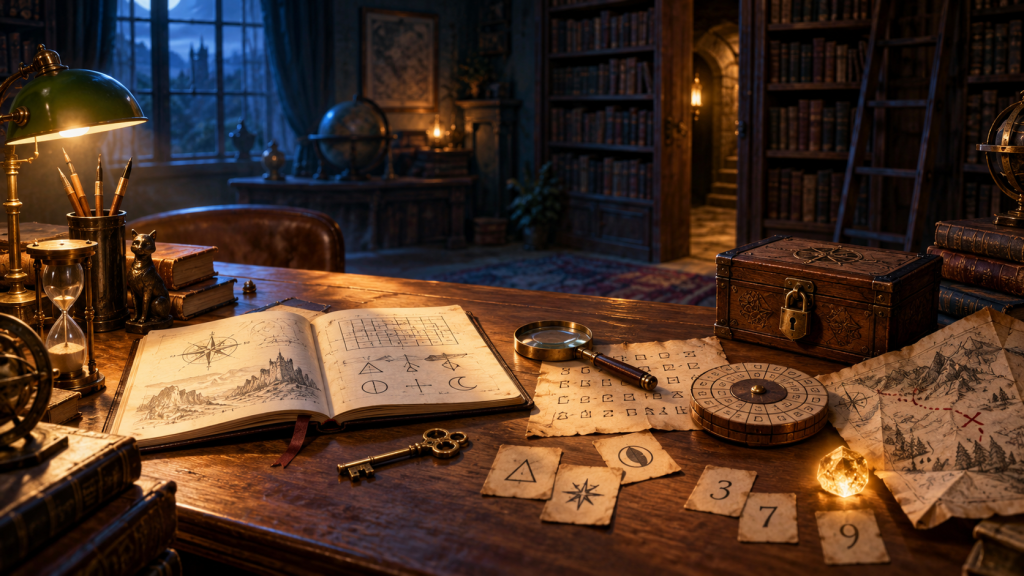
They notice the strange symbol in the corner of the page. They stop at a coded message. They try to work out the answer before the characters do. And if a book includes a hidden passage, secret map, riddle, or impossible room, they’re already halfway in.
Puzzle-driven books can be especially appealing to kids who like mystery, logic, games, escape rooms, or anything that makes reading feel interactive.
The books below mix story with riddles, clues, codes, secrets, logic, and problem-solving.
1. The Mysterious Benedict Society — Trenton Lee Stewart
Best for: Logic puzzles and clever teamwork
Puzzle level: High
Why it works: The characters are constantly tested by problems that reward observation and creative thinking
When Reynie Muldoon answers an unusual advertisement, he is drawn into a series of tests and eventually recruited alongside other gifted children for a secret mission.
The fun comes from the fact that problems are rarely solved by strength.
They are solved by paying attention, questioning assumptions, and thinking differently.
For readers who love puzzles that feel like part of the plot rather than decoration, this is one of the strongest choices.
2. Escape From Mr. Lemoncello’s Library — Chris Grabenstein
Best for: Escape-room fans
Puzzle level: High
Why it works: The entire story revolves around solving the way out
A group of children gets the chance to spend the night inside an extraordinary new library designed by a famous game maker.
Then the doors stay locked.
To escape, they have to solve clues, uncover hidden connections, and use the library itself as part of the game.
This is a particularly good choice for kids who like:
- scavenger hunts
- board games
- hidden clues
- escape rooms
- wordplay
The puzzles are not just side activities.
They are the story.
3. The Westing Game — Ellen Raskin
Best for: Readers who like complicated mysteries
Puzzle level: High
Why it works: The reader is invited to piece together clues along with the characters
Sixteen people are brought together under mysterious circumstances and divided into teams after the death of millionaire Samuel Westing.
His will presents them with a challenge.
Someone among them may be responsible for his death.
The clues seem disconnected at first, but patterns begin to emerge.
This is a good choice for readers who enjoy taking notes, remembering small details, and trying to solve the mystery before the final reveal.
4. The Name of This Book Is Secret — Pseudonymous Bosch
Best for: Secrets, codes and unusual narration
Puzzle level: Moderate to high
Why it works: Everything feels like it may contain another clue
Cass and Max-Ernest become involved in a mystery involving a magician, strange experiments, coded messages and secrets that probably should have stayed hidden.
Even the narrator seems reluctant to tell you too much.
That gives the entire book the feeling of a puzzle.
Readers who enjoy strange details and hidden meaning will have plenty to investigate.
5. The Mystery of the Radcliffe Riddle — Taryn Souders
Best for: Riddle-focused mystery fans
Puzzle level: High
Why it works: The central mystery itself revolves around solving a riddle
This is one of the clearest fits on the list for readers specifically looking for a mystery built around riddles.
The story centers on a puzzling inheritance and the clues needed to understand it.
Kirkus specifically described it as a riddle-focused mystery, which makes it particularly relevant for readers who enjoy decoding clues rather than simply following a detective.
6. The Parker Inheritance — Varian Johnson
Best for: Readers who like history mixed with clues
Puzzle level: Moderate to high
Why it works: A hidden mystery unfolds through letters, clues and investigation
Candice discovers a mysterious letter connected to her grandmother and an old injustice in their town.
The letter points toward a puzzle involving history, family secrets, and a possible fortune.
What makes this one especially interesting is how the mystery connects the present to events from the past.
It rewards readers who like solving clues while also discovering why those clues matter.
7. The 39 Clues: The Maze of Bones — Rick Riordan
Best for: Fast-paced clue hunting
Puzzle level: Moderate
Why it works: The story is built around a global race to solve clues
After the death of their grandmother, siblings Amy and Dan Cahill discover that their family history contains a much larger mystery.
They are given a choice:
accept an inheritance,
or enter a competition involving thirty-nine clues scattered around the world.
The result is part mystery, part adventure, and part treasure hunt.
It works well for readers who enjoy constant forward motion and collecting pieces of a larger puzzle.
8. The Crooked Manor Chronicles — Arthur Crate
Best for: Riddles, magical mystery and strange places
Puzzle level: Moderate
Why it works: The Manor itself feels like something readers have to figure out
In The Crooked Manor Chronicles, the mystery begins with a place that refuses to behave normally.
Rooms shift.
Paintings seem a little too aware.
Clues appear where they shouldn’t.
And riddles are not just decorations—they matter.
The story combines fantasy mystery with puzzles, friendship and an eerie manor that seems to have rules of its own.
It is aimed roughly at readers ages 8–13, especially those who like the idea that a story might be hiding something from them.
[Discover The Crooked Manor Chronicles →]
9. Book Scavenger — Jennifer Chambliss Bertman
Best for: Kids who love clues hidden inside books
Puzzle level: High
Why it works: Books themselves become part of the mystery
Emily loves Book Scavenger, a game in which books are hidden around the country and players solve clues to find them.
When the game’s creator is attacked, Emily and her friend James discover that a mysterious book may be connected to what happened.
The story combines:
- coded messages
- literary clues
- scavenger hunting
- real-world exploration
For kids who already like books and puzzles, this one can be especially appealing.
What kind of puzzle book does your reader like?
Not every puzzle-heavy story works the same way.
Some books ask readers to solve logic problems.
Others use codes and ciphers.
Some focus on riddles.
Others turn the whole plot into one giant mystery.
For logic and strategy
Try:
- The Mysterious Benedict Society
- The Westing Game
For codes and hidden clues
Try:
- The Name of This Book Is Secret
- Book Scavenger
- The Parker Inheritance
For riddles
Try:
- The Mystery of the Radcliffe Riddle
- The Crooked Manor Chronicles
For escape-room style puzzles
Try:
- Escape From Mr. Lemoncello’s Library
For fast adventure and clue hunting
Try:
- The 39 Clues
Why puzzle stories work so well for some readers
Mystery books naturally encourage readers to pay closer attention.
Scholastic notes that mysteries can encourage children to use reading comprehension and critical thinking as they piece together clues and solve problems.
That changes the role of the reader.
Instead of only asking:
What happens next?
they begin asking:
What did I miss?
Why did that character say that?
Is that detail important?
Can I solve this before they do?
For some kids, that feeling of participation makes reading much more engaging.
Try a few riddles before choosing your next book
If your reader likes puzzles but you’re not sure whether they want an entire puzzle-driven novel, start smaller.
Arthur Crate’s 7 Curious Riddles for Kids Who Love a Mystery gives them a few mysteries to solve without committing to a whole book.
And if they want something more interactive, they can step into Enter the Manor, where the riddles become part of the experience.
How to choose a puzzle book for a young reader
A good puzzle book should challenge the reader without making the story feel like homework.
Look for a balance between:
- a story they care about
- puzzles they can understand
- clues they have a fair chance of noticing
- satisfying answers
- characters worth following
If every puzzle requires an adult to explain it, frustration can replace curiosity.
But when a reader solves even one clue before the characters do?
That’s often the moment they become invested.
They are no longer just reading the mystery.
They are part of it.